History and Principles of User Experience
User experience is a branch of computer-human interaction. This is a discipline that has shaped the dialogue between users and devices since the dawn of computing. It is where data input and output occurs through the interfaces people interact with. Today, these interfaces have become diverse, leading to a research field dedicated to studying people's interactions with devices—physical products, such as elevators, and virtual interfaces, such as websites and applications. Each interface has its own goals—an elevator takes a user to the floor they intend to visit. Defining the goals of websites and mobile applications is more difficult, as they are visited by very different people with different goals and needs. Studying user experience is important for identifying these groups of people, their common or distinct needs, and creating page designs that align with these goals.
Goals and the Importance of Audiences in User Experience
First, user types are defined, followed by use cases and corresponding goals. Based on these goals, we can measure whether the goal is being achieved successfully and without obstacles. Obstacles can be substantive, technological, and subjective for each audience. Difficulties lie in perception, emotion, and cognitive load. A good user experience on a website provides the ability to achieve the goal for which a person came to the site without obstacles or difficulties.
These goals are very diverse:
On the homepage of a search engine – to find what they are looking for.
In an online store – to receive the selected product.
Book a ticket, a room, a trip.
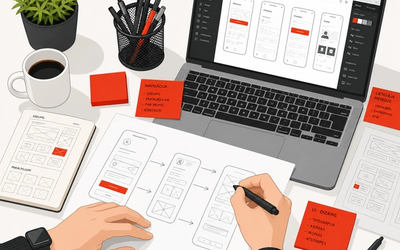
There are corresponding audiences for these goals. By adding quantitative characteristics to audiences – age, gender, location, technology used, devices, internet connection – we can model one segment of the user. By adding qualitative characteristics to these audiences – attitudes, needs, habits – we can model the user profile for which the page is intended. From this profile, we derive usage scenarios that lead to goal achievement via the shortest (or several) paths. The pre-programming process is lengthy – sketches, prototypes, tests, design sketches, prototypes, tests, until the best option is iteratively reached. Only when the data is collected and the hypothesis is confirmed in user testing is it programmed. User experience consists of a research phase, prototype testing, and then UX design.
Image from user tests to determine how people hold their phones to choose the most convenient menu layout on mobile devices.