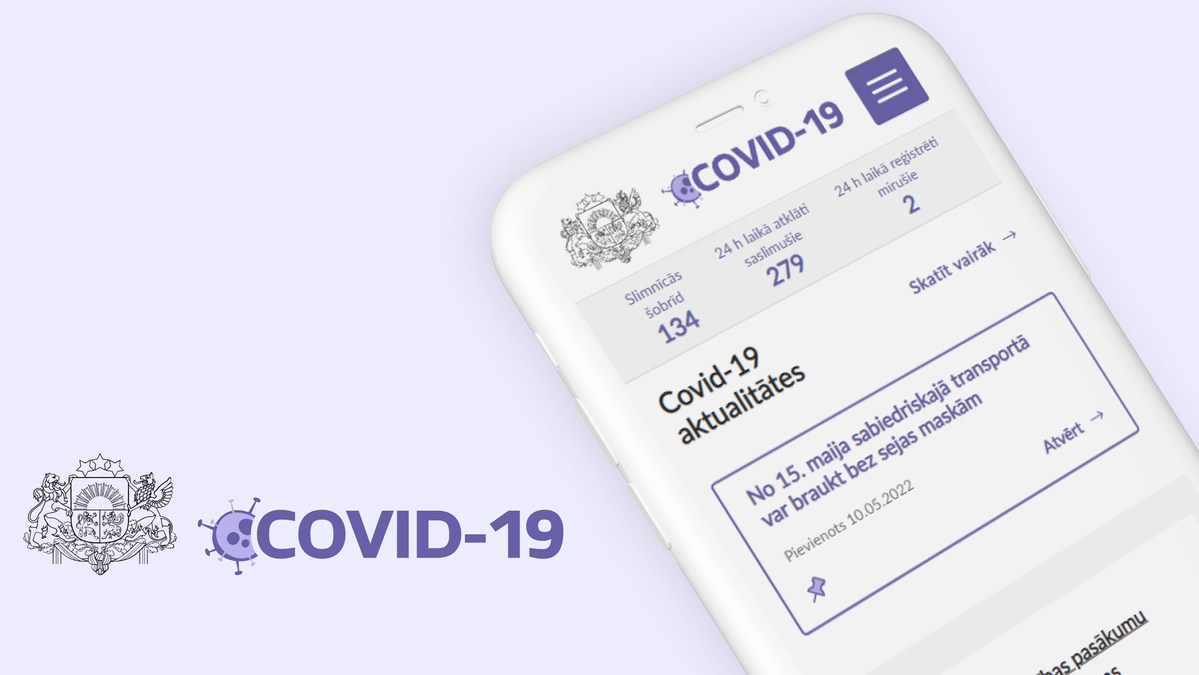
On March 12, a state of emergency was declared in the country, and by March 25, a unified information website about Covid-19 had been launched. While this otherwise bureaucratic and expensive project was being developed incredibly quickly and on a limited budget, this time around.
No time for a briefing.
At the beginning of the pandemic, it became immediately clear that public misinformation was one of the most dangerous threats to national security during the Covid-19 outbreak. Although the government explained the changes to the press and the public at regular briefings, it wasn't enough. Formal statements were overshadowed by rumors, misunderstandings, and discontent, and searching for additional information online revealed no single, official website.
The Center for Disease Prevention and Control and the State Chancellery took on the project. Not because it was their job, but because at that point, the Ministry of Health staff were already under inhumane strain, fighting an unknown enemy. At such moments, even the state apparatus begins to operate under the "we're doing everything we can" model.
We understood the difference from other projects from the very first minute. Typically, a project like this would have started slowly—a brief would have landed in our inbox with a week to review, followed by meetings, proposal approval, strategy development, and cost haggling. Not this time. Work began with a question from Ilze Pavlova, Head of the State Chancellery's Communications Department: "Can you build us a website by tomorrow?" Of course, we can. We accepted the budget as a fact, the deadline as a challenge.
Intuition instead of strategy.
Of course, "by tomorrow" was a figurative expression for the page to be ready in less than two weeks. What did this mean for the development team? First and foremost, they needed to understand how to climb the ladder, skipping at least two rungs at each step. The strategic direction and initial sketches were created literally overnight, by studying websites from other countries, selecting the most successful examples, and taking the best from each.
The main challenge that needed a solution was reducing the gap between official statements and the public. Therefore, we intuitively and immediately decided that the foundation of our strategy would be user-focused content and structure. This began with ensuring that everything on the website was quickly accessible and ended with explaining the information in simple language, free from bureaucratic complexity and unnecessary details.
Another challenge is that information is constantly changing, and as the situation evolved, it became clear that its priorities would also shift. For example, initially, explaining the repatriation process was crucial, but it had a deadline. Therefore, together with the State Chancellery, we agreed on two things. First, the website would feature "essential" information that would link to the pages of relevant institutions. Second, it would be possible to change the order in which information blocks appear. This way, when, for example, major changes occur in the education system, they would be immediately apparent upon entering the website.
This important foundation, on which the entire project was subsequently based, was created at breakneck speed. We should be grateful here for the fact that not only our team but also the team at the State Chancellery was ready to respond and approve our ideas around the clock. Thus, in a short time, we overcame not just two but four stages.
12 people in three shifts
To launch the page in a completely unprecedented timeframe, iConcept deployed all available human resources. Twelve people worked in three shifts, distributing responsibilities across stages and replacing each other when they simply couldn't cope.
In the first days, we decided to launch the website in two stages. On March 25, we published the basic page with frequently asked questions and important contact information, as well as links to other institutions' pages. On April 3, we published expanded information blocks, statistics, and additional design solutions.
A skyscraper can be built on a good foundation.
We are proud that Covid.gov.lv doesn't look like a project created in a few weeks, and that the site is at the top of Google results. It's great that, in collaboration with Info.gram, we were able to create an interactive statistics page where users can easily access the latest data.
However, we're most excited about the website's unseen side. No matter how quickly, the work must be done thoroughly. We believe that every website needs a good structure and a user-friendly administration panel—that's how we create a sustainable product. And this time, we succeeded, despite the unimaginable timeframe. Because the foundation is so strong, we see the site's potential to continue functioning and serving as a unified crisis communications channel even after the Covid-19 pandemic.